
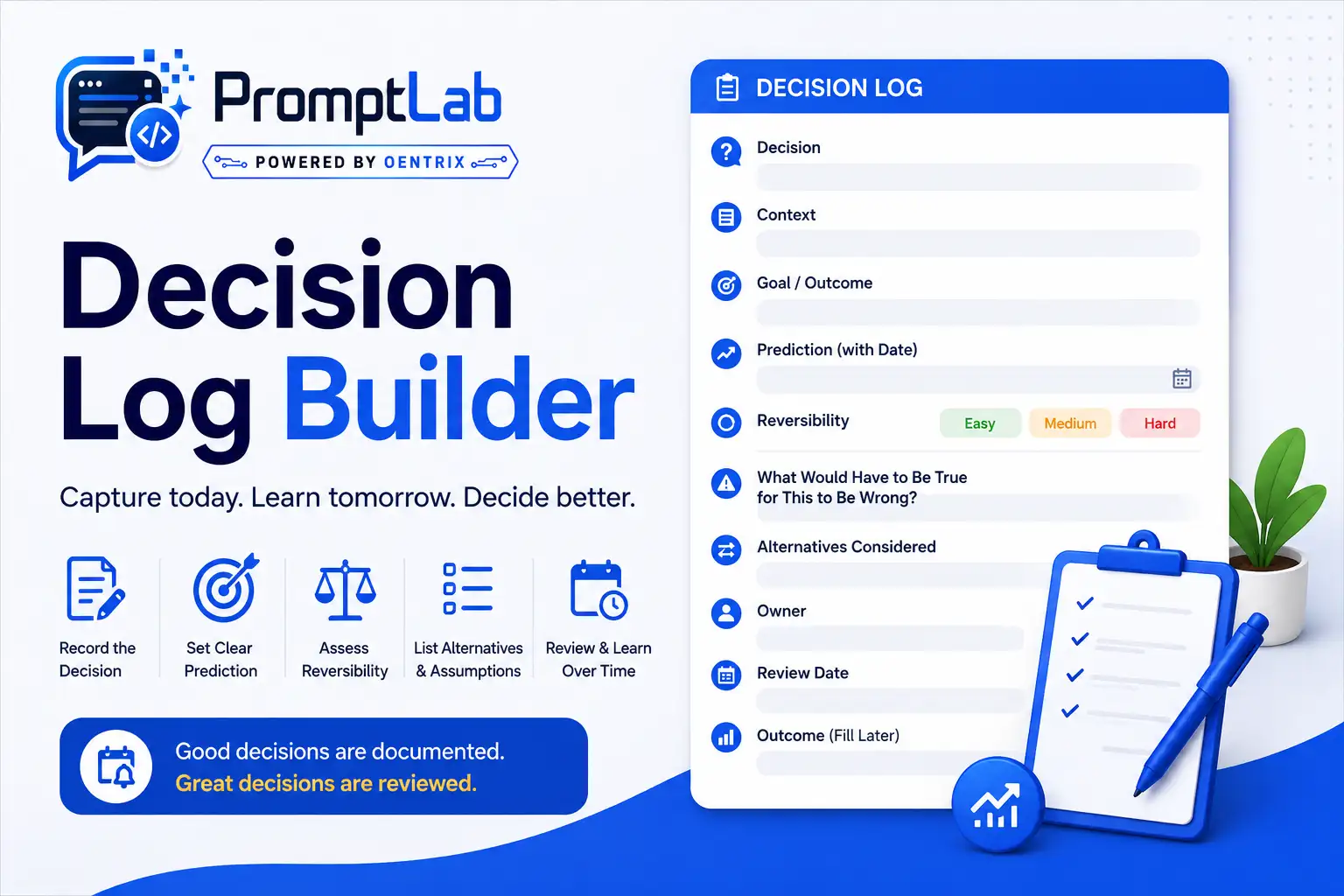
Decision Log Builder
28 views · 0 copies · 0 likes
Almost nobody records why they decided something, and the cost of that shows up later in two specific ways. First, decisions get relitigated - a question settled in March returns in July because nobody remembers the reasoning, and the same three people have the same argument. Second, and more damaging, you never learn whether your judgement is any good, because you cannot compare an outcome against a prediction you never wrote down.
The second problem is the serious one. Without a written prediction, hindsight quietly rewrites what you expected. Outcomes feel more foreseeable than they were, and a decision that went badly gets remembered as obviously risky while a lucky one gets remembered as skilful. You accumulate experience without accumulating judgement, which is why years in a role and quality of decisions correlate far less than people assume.
This prompt captures a decision in a structured form designed for later review. The critical field is the falsifiable prediction with a date. Not this should improve retention, but retention for this cohort will be above twenty percent at ninety days, checked on the fifteenth. A prediction you cannot be wrong about teaches you nothing.
The reversibility assessment does real work too. Decisions that can be undone cheaply deserve speed, not deliberation, and treating them as weighty is a common and expensive habit. Genuinely irreversible decisions deserve the opposite. Recording which kind you thought this was is often more revealing in review than the decision itself.
The field people skip and should not is what would have to be true for this to be wrong. It forces you to name your assumptions while you can still see them, and it converts a vague unease into a specific thing to watch. Very often the honest answer surfaces a check you can run this week for almost nothing.
The rejected alternatives matter for a reason people underestimate. When a decision is revisited later, the question is almost always why did we not just do X - and X was usually considered and rejected for a reason that no longer exists or still holds. Either answer resolves the discussion in a minute.
How to use it. One entry takes about ten minutes and is worth it only for decisions that are expensive to reverse or that you expect to be questioned. Logging everything guarantees the habit collapses. Set a calendar reminder for the review date at the moment you write the entry, because a log nobody revisits is just a diary.
You capture a decision in a structured, reviewable form. Ask for anything missing before producing the entry. Do not fill gaps with assumptions.

INPUTS
The decision: [what is being decided]
Context: [why this is being decided now]
Options considered: [list them]
Who decides: [name or role]

Produce a DECISION LOG ENTRY with exactly these fields.

DATE - today.
DECISION - one sentence stating what was chosen. Written so a reader in a year understands it without context.
STATUS - PROPOSED, DECIDED, or SUPERSEDED.
DRIVER - what forced a decision now rather than later. If nothing did, say so, because that is worth noticing.
OPTIONS CONSIDERED - each option with the reason it was rejected. Be specific. Rejected as too expensive is not useful in a year - state the figure or the constraint.
REVERSIBILITY - classify as EASILY REVERSED, COSTLY TO REVERSE, or EFFECTIVELY PERMANENT, and state the actual cost and time to undo it.
ASSUMPTIONS - what must be true for this to be correct. For each, mark whether it is VERIFIED, ASSUMED, or UNKNOWN.
FALSIFIABLE PREDICTION - a specific measurable outcome with a date. It must be possible to be wrong. Reject any prediction that cannot fail and rewrite it.
WHAT WOULD MAKE THIS WRONG - the observable signals that would indicate this was a mistake, and roughly when they would appear.
CHEAP CHECKS AVAILABLE NOW - anything that could test a key assumption this week at low cost.
REVIEW DATE - when to compare outcome against prediction.

After the entry, output REVIEW QUESTIONS - the three questions to ask on the review date. These must be answerable with evidence, not opinion.

RULES
If the prediction cannot be falsified, say so and rewrite it until it can.
If no option was seriously considered besides the chosen one, flag that explicitly as a risk.
Do not evaluate whether the decision is good. Your job is to record it so it can be evaluated later.
Do not soften an assumption marked UNKNOWN into one that sounds verified.
Recommended AI Model
This prompt works best with Claude 3.5 Sonnet, GPT-4o, o1. Other capable models will also work - compare them on our AI Models page.
Prompt Guide
How to Use
Copy the prompt below and paste it into Claude 3.5 Sonnet, GPT-4o, o1. Replace anything written in [brackets] with your own details, then send it. The more context you give about your goal, audience and tone, the better the result will be for Productivity work.
Step-by-step Instructions
- 1 Click the Copy button on the prompt above.
- 2 Open Claude 3.5 Sonnet, GPT-4o, o1 and start a new chat.
- 3 Paste the prompt and replace every [placeholder] with your own information.
- 4 Send the prompt and read the first draft carefully.
- 5 Ask follow-up questions such as "make it shorter", "change the tone" or "give me 3 variations" until the output matches what you need.
Recommended AI Model
Claude 3.5 Sonnet, GPT-4o, o1
Tips
- Be specific: mention your audience, goal and preferred length.
- Add an example of the style you like so the AI can match it.
- Ask for the output in a table or list when you need structure.
- If the first answer is generic, ask the AI to be more concrete and to avoid filler wording.
- Save the versions that work well so you can reuse them later.
Expected Output
A ready-to-use result for "Decision Log Builder" that you can refine further with follow-up messages. Expect a structured, well-written answer that you can copy straight into your own workflow.
Related Prompts
Weekly Review Facilitator
Almost everyone who tries a weekly review abandons it within a month. The usual explanation is discipline, which is wron
Inbox Triage Ruleset
Inbox advice fails because it is generic. Every guide recommends the same four folders and the same two minute rule, and
Comments (0)
No comments yet. Be the first to share your results.