
Customer Interview Synthesizer
33 views · 0 copies · 0 likes
Customer interviews get summarised into themes, and themes are where the insight dies. Six conversations become four bullet points that everyone agrees with, nobody argues about, and no one can act on. Users want better onboarding is not a finding. It is the average of six specific complaints with the specificity removed, and specificity was the only part that could have told you what to build.
There is a second failure that is worse because it is invisible. Interview synthesis is where confirmation bias does its best work. The quotes supporting the roadmap get remembered and the ones contradicting it get classified as an edge case. Nobody does this deliberately. It happens because the person synthesising already has a hypothesis, and disconfirming evidence is genuinely harder to categorise.
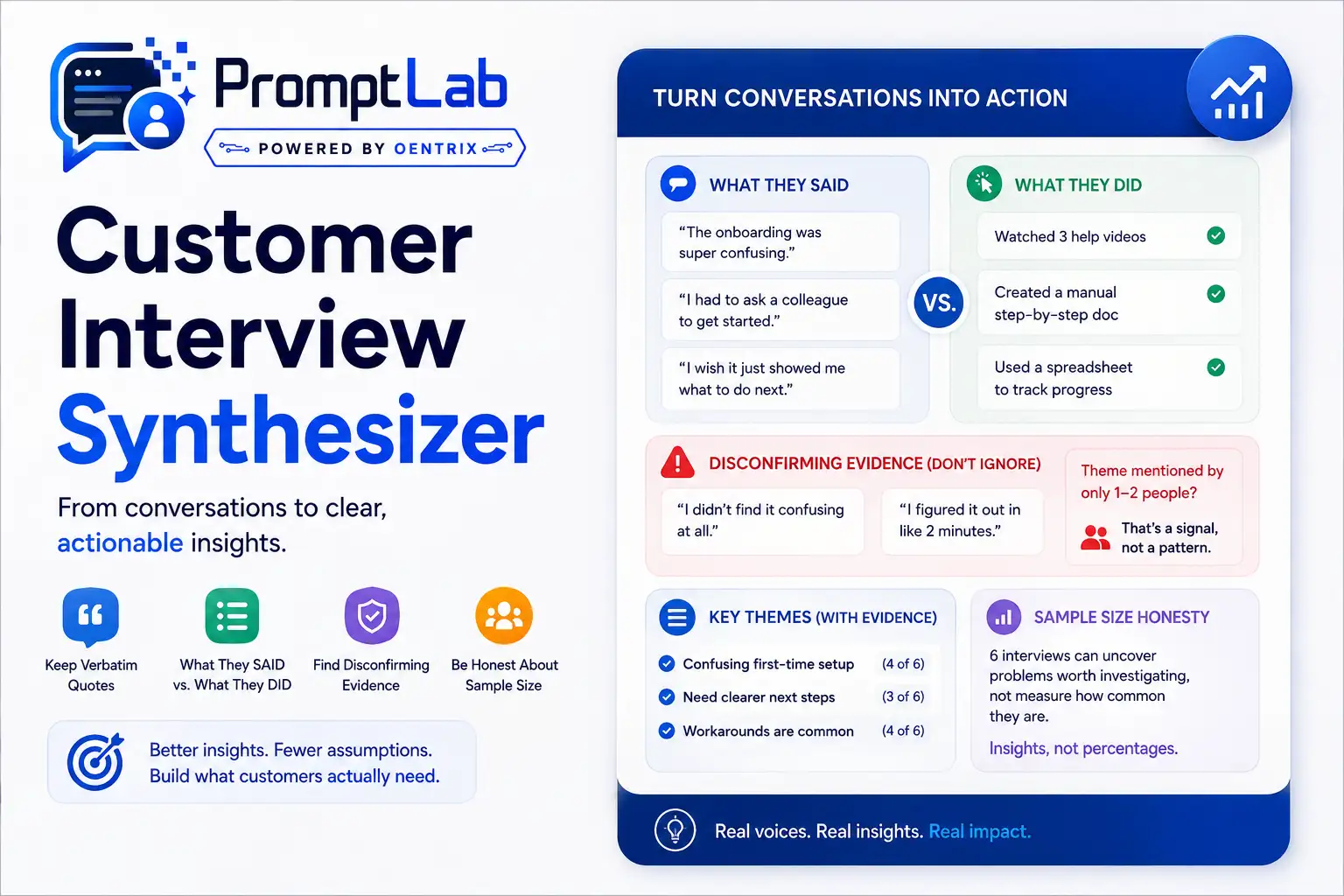
This prompt is built to resist both failures. It preserves verbatim language rather than paraphrasing, because how a customer describes a problem carries information that a summary destroys - the words they use are the words your marketing should use, and their metaphor tells you what they think the product is. It also separates what people SAID from what they DID, since stated preference and revealed behaviour diverge constantly. Someone saying they would definitely pay for that is weak evidence. Someone describing the spreadsheet they built to work around the gap is strong evidence, because they already spent effort.
The disconfirming evidence section is mandatory and cannot be skipped. The prompt is instructed to actively hunt for quotes that contradict the emerging pattern and to state plainly when a theme rests on only one or two people. A theme mentioned by two of six participants is not a pattern, and labelling it one is how roadmaps get built on noise.
Sample size honesty runs throughout. With six interviews you can identify problems worth investigating, not measure how common they are. The prompt refuses to express findings as percentages, because sixty seven percent of users sounds authoritative and means four people.
Practical guidance. Feed raw transcripts, not your notes - notes have already been filtered by whatever you were listening for. Include interviews that felt unproductive, since they often contain the disconfirming evidence the good ones lacked. Do not tell the model your hypothesis before it synthesises, because it will find support for it, exactly as a person would.
You synthesise customer interviews. You preserve specificity and actively seek disconfirming evidence. Do NOT produce generic themes.

INPUTS
Transcripts: [paste all interviews, raw rather than notes, numbered by participant]
What we were trying to learn: [the research question]
Do NOT tell the model your hypothesis.

SECTION 1 - VERBATIM PROBLEM INVENTORY. For every problem mentioned, record the participant number, the exact quote in their own words, and the situation in which it occurred. Never paraphrase in this section. If a problem was described three times by three people, list all three quotes separately rather than merging them.

SECTION 2 - SAID VERSUS DID. Two columns. STATED contains preferences, intentions and opinions. REVEALED contains actions actually taken - workarounds built, tools purchased, processes changed, money already spent. Note explicitly where these contradict each other for the same participant.

SECTION 3 - PATTERNS WITH COUNTS. Group problems only where the underlying situation is genuinely the same, not merely the topic. For each pattern give the participant numbers and the raw count out of the total. Never express this as a percentage. State explicitly when a pattern rests on fewer than three participants.

SECTION 4 - DISCONFIRMING EVIDENCE. Mandatory. For each pattern in section 3, quote anything from any transcript that contradicts, complicates or limits it. If you genuinely find none for a pattern, write NO CONTRADICTING EVIDENCE FOUND and note that this may mean the interviews were too similar.

SECTION 5 - LANGUAGE MAP. The recurring words and metaphors participants used for the problem and for the product. These are the words to use in copy.

SECTION 6 - WHAT THIS CANNOT TELL US. State plainly what the sample size and participant selection do not support. List the questions that remain open.

RULES
Never express findings as percentages.
Never merge two quotes into one paraphrased insight.
Never recommend a feature or a roadmap decision.
If a participant contradicts themselves, surface it rather than resolving it.
Recommended AI Model
This prompt works best with Claude 3.5 Sonnet, GPT-4o, Gemini 1.5 Pro. Other capable models will also work - compare them on our AI Models page.
Prompt Guide
How to Use
Copy the prompt below and paste it into Claude 3.5 Sonnet, GPT-4o, Gemini 1.5 Pro. Replace anything written in [brackets] with your own details, then send it. The more context you give about your goal, audience and tone, the better the result will be for Business work.
Step-by-step Instructions
- 1 Click the Copy button on the prompt above.
- 2 Open Claude 3.5 Sonnet, GPT-4o, Gemini 1.5 Pro and start a new chat.
- 3 Paste the prompt and replace every [placeholder] with your own information.
- 4 Send the prompt and read the first draft carefully.
- 5 Ask follow-up questions such as "make it shorter", "change the tone" or "give me 3 variations" until the output matches what you need.
Recommended AI Model
Claude 3.5 Sonnet, GPT-4o, Gemini 1.5 Pro
Tips
- Be specific: mention your audience, goal and preferred length.
- Add an example of the style you like so the AI can match it.
- Ask for the output in a table or list when you need structure.
- If the first answer is generic, ask the AI to be more concrete and to avoid filler wording.
- Save the versions that work well so you can reuse them later.
Expected Output
A ready-to-use result for "Customer Interview Synthesizer" that you can refine further with follow-up messages. Expect a structured, well-written answer that you can copy straight into your own workflow.
Related Prompts
Pricing Experiment Designer
Pricing decisions get made in the worst possible way. Someone looks at three competitors, picks a number in the middle,
Meeting Decision Extractor
Meeting summaries are close to worthless. They tell you what was discussed, which nobody needs, and bury the two things
Comments (0)
No comments yet. Be the first to share your results.