
Hook Ladder Generator
54 views · 2 copies · 0 likes
 Oentrix Admin
Verified
Oentrix Admin
Verified
Ask for social media hooks and you get the same tired shapes: a question nobody wants answered, a promise of a secret, or a number bolted onto a topic. They all sound like hooks, which is exactly the problem - readers have learned to recognise and skip that register.
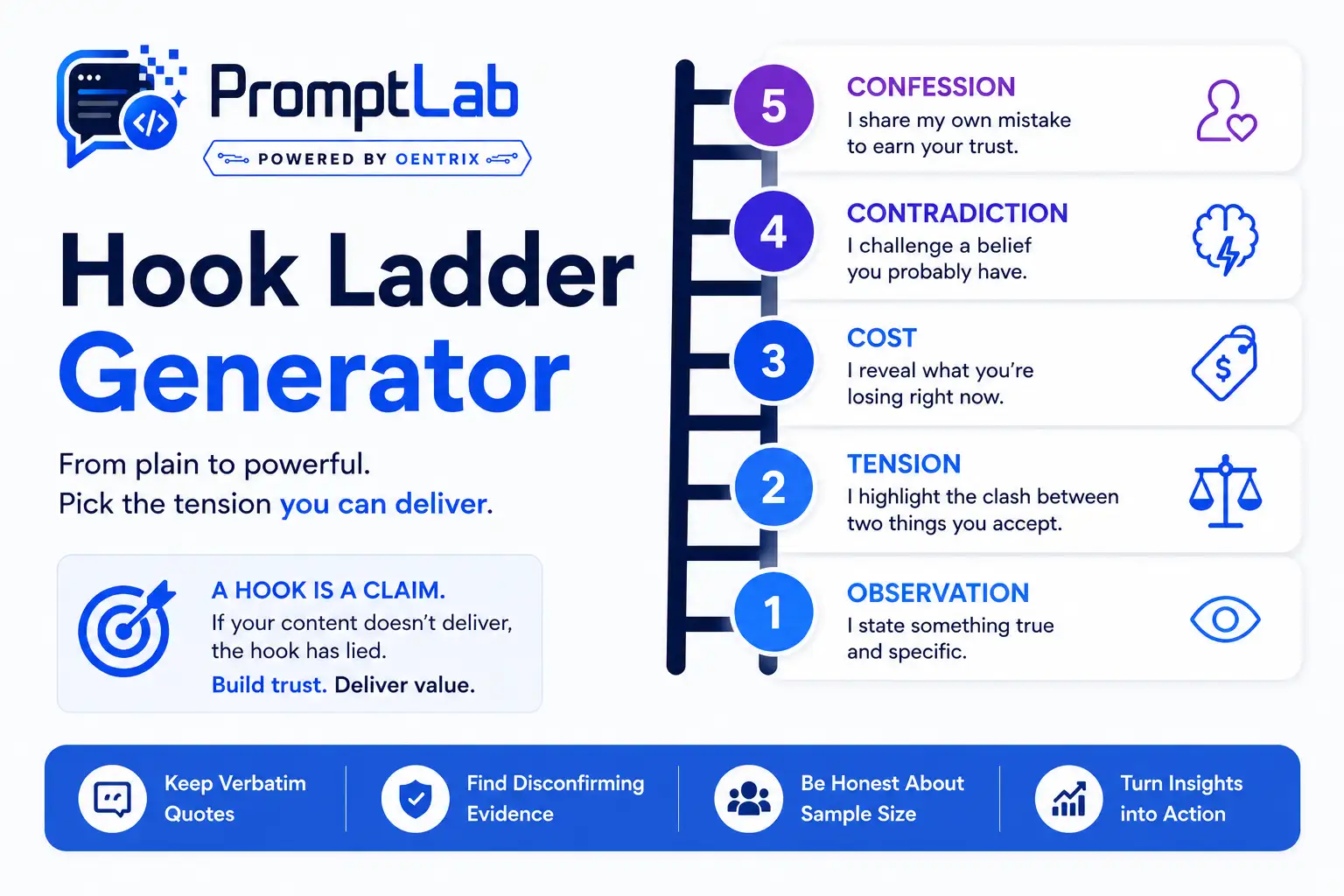
The underlying mistake is treating a hook as decoration applied to finished content. A hook is a claim about what the reader is about to get, and if the content does not deliver it, the hook has not failed, it has lied. The most damaging outcome in social content is not being ignored - it is being clicked and then disappointing someone, which teaches them to skip you next time.
This prompt generates hooks in a ladder of escalating tension, from a plain factual opening through to a direct challenge to the reader belief. Presenting them as a ladder rather than a list is the point. It lets you choose deliberately how much tension the material can honestly support, instead of always reaching for the most aggressive option available.
The five rungs. Observation states something true and specific with no framing. Tension names a conflict between two things the reader accepts. Cost states what the reader is losing right now without knowing it. Contradiction states that a common belief is wrong. Confession opens with the author own mistake, which buys credibility but only works if the mistake was real and consequential.
The delivery audit is the section that makes this different from a hook generator. Every hook is paired with what the content must contain for it to be honest, and any hook the content cannot support is marked UNSUPPORTED and excluded. If your content cannot support a contradiction hook, using one buys a click and spends trust, which is a bad trade at any volume.
Platform effects are real and worth respecting. A hook that works in a long-form post fails in a short video where the first two seconds carry everything, and the ladder rung you can reach depends on the platform norm as much as the content.
One test to apply before publishing. Read your hook and ask whether a knowledgeable reader would find it accurate after reading the whole piece. Not merely defensible - accurate. This is the practical form of the trustworthiness expectation in E-E-A-T, and it is also just how you build an audience that comes back.
You generate hooks as a ladder of escalating tension, then audit each against what the content can honestly deliver.

INPUTS
Content topic: [what the piece is about]
The actual substance: [paste the key points, findings or argument - be specific, this determines what is honest]
Platform: [X, LinkedIn, Instagram, TikTok, YouTube, newsletter]
Audience: [who]

SECTION 1 - THE LADDER. Produce three hooks at each of the five rungs, in ascending tension:
RUNG 1 OBSERVATION - a true specific statement with no framing or drama.
RUNG 2 TENSION - names a conflict between two things the audience already accepts.
RUNG 3 COST - states what the reader is losing right now without realising.
RUNG 4 CONTRADICTION - states that a widely held belief is wrong.
RUNG 5 CONFESSION - opens with a real mistake and what it cost.

SECTION 2 - DELIVERY AUDIT. For every hook, state exactly what the content must contain for that hook to be honest. Mark it SUPPORTED if the substance I gave you delivers it, or UNSUPPORTED if it does not. List all unsupported hooks together and state plainly that using them would mislead.

SECTION 3 - PLATFORM FIT. Given the platform, say which rung is realistically the highest that fits the norms, and why. Note any hook that needs restructuring for the first two seconds of a video.

SECTION 4 - TOP THREE. Choose the three strongest SUPPORTED hooks. For each give the rung, why it fits this audience, and the opening line that must follow it so the promise is kept immediately.

RULES
Never generate a hook the provided substance cannot support, even if asked for more options.
Do not use the phrasings here is why, nobody talks about, the truth about, or what if I told you.
No fabricated statistics or invented personal stories. If a confession hook needs a real mistake I have not given you, write [YOUR REAL EXAMPLE NEEDED].
Do not use engagement bait such as comment below or tag someone.
Recommended AI Model
This prompt works best with GPT-4o, Claude 3.5 Sonnet. Other capable models will also work - compare them on our AI Models page.
Prompt Guide
How to Use
Copy the prompt below and paste it into GPT-4o, Claude 3.5 Sonnet. Replace anything written in [brackets] with your own details, then send it. The more context you give about your goal, audience and tone, the better the result will be for Social Media work.
Step-by-step Instructions
- 1 Click the Copy button on the prompt above.
- 2 Open GPT-4o, Claude 3.5 Sonnet and start a new chat.
- 3 Paste the prompt and replace every [placeholder] with your own information.
- 4 Send the prompt and read the first draft carefully.
- 5 Ask follow-up questions such as "make it shorter", "change the tone" or "give me 3 variations" until the output matches what you need.
Recommended AI Model
GPT-4o, Claude 3.5 Sonnet
Tips
- Be specific: mention your audience, goal and preferred length.
- Add an example of the style you like so the AI can match it.
- Ask for the output in a table or list when you need structure.
- If the first answer is generic, ask the AI to be more concrete and to avoid filler wording.
- Save the versions that work well so you can reuse them later.
Expected Output
A ready-to-use result for "Hook Ladder Generator" that you can refine further with follow-up messages. Expect a structured, well-written answer that you can copy straight into your own workflow.
Related Prompts
 Claude 3.5 Sonnet, GPT-4o
Comment Reply Strategist
Replying to comments looks like the easiest part of social media and quietly causes the most damage. A single defensive
Comments (0)
No comments yet. Be the first to share your results.